
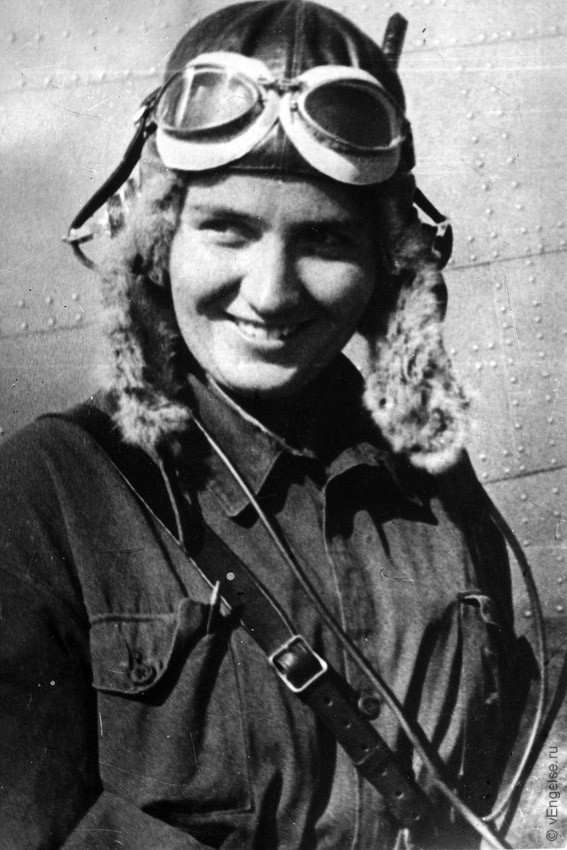
Hero of the Soviet Union
March 28, 1912 – January 4, 1943
(aged 30)
“Marina never did anything halfway.
E. A. Migunova, “Prodolzheniie Podviga,” in Zapiski Shturmana/Prodolzheniie Podviga (Moscow: DOSAAF, 1976), p242.
“She was not able to live just any old way,
or stand on the side of the road.
She needed room for a big flight.
That was what her nature demanded:
whole, impetuous, and strong willed.”
Marina Malinina was born to parents who envisioned a career in music for her. However, her father’s death when she was only six years old put the family in a bad financial situation, and Marina decided to pursue chemistry as a more profitable profession than music. She married Sergei Raskov when she was about 18 years old and divorced him six years later, keeping custody of their daughter Tania.
In 1931 Raskova began working as at the Zhukovsky Air Force Engineering Academy in Moscow, where she served as a laboratory assistant for A. V. Belyakov (famous for his participation in a polar flight from Russia to the United States). Belyakov’s specialty was navigation, and Raskova became fascinated with the subject. In 1933 Marina Raskova became the first woman to qualify as an Air Force navigator. She subsequently became an instructor at the Zhukovsky Academy, which sponsored her continued training as both a navigator and a pilot.
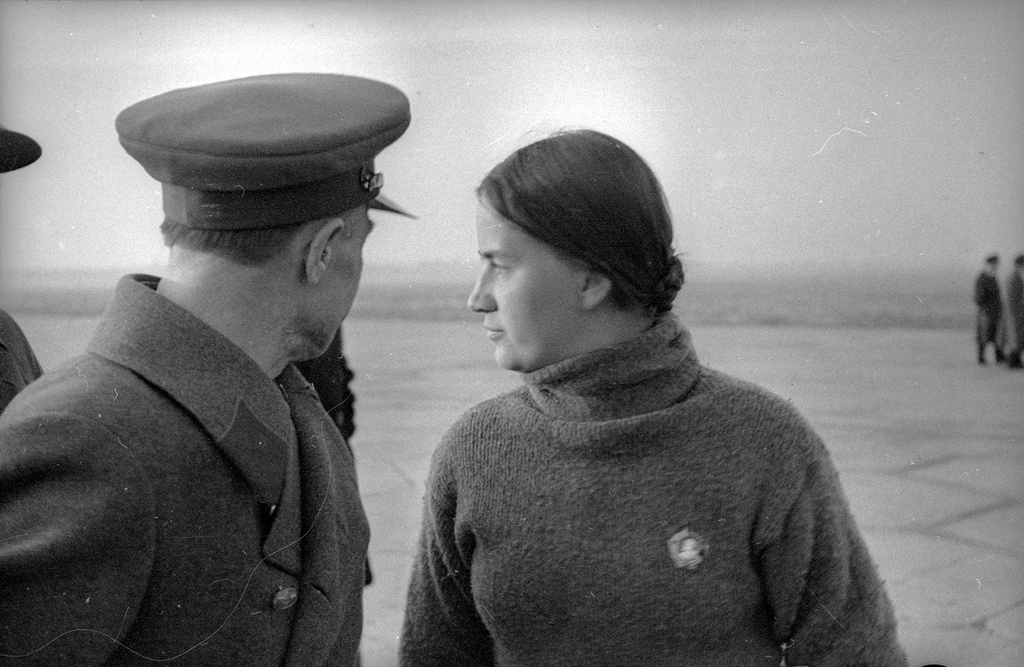
In the late 1930s she participated in a series of record-setting flights. Raskova was best-known for her role in a 1938 flight, when she and two pilots set a new women’s record for distance. The flight was planned by pilot Valentina Grizodubova who brought in Polina Osipenko as copilot and Marina Raskova as navigator. In an aircraft named Rodina (“Motherland”), the three women flew from Moscow to the Far East, nearly 3,700 miles, a nonstop flight of some 25-30 hours over the wild terrain of Siberia. The Rodina took off on 24 September 1938, but icing, poor visibility near the destination, and low fuel required the crew to make a forced landing in the desolate and swampy Far East. Raskova had to bail out before the landing in order to lighten the plane; she spent ten days wandering in the taiga with little food and no water. A massive air search finally located the Rodina and Raskova.
The episode garnered the kind of public attention in the Soviet Union that Lindbergh’s crossing of the Atlantic had in the West. Stalin hosted a Kremlin reception for the Rodina’s crew upon their return to Moscow. Raskova, Grizodubova, and Osipenko became the first women to receive the Hero of the Soviet Union award, and the only women to receive it before the war. One female pilot wrote of Moscow in the late 1930s, “in those years, the names of Grizodubova and Raskova . . . were on everyone’s lips.”
Raskova wrote that after the flight, she and her colleagues received many letters asking them to tell the story of how they became pilots. She decided to write an account of her life, including her ordeal in the taiga, published in 1938 as Notes of a Navigator. Raskova was as famous in her native country as was Amelia Earhart or Jacqueline Cochran in the United States. Her example inspired many Soviet women to learn to fly; young girls pasted her newspaper photographs into their notebooks, as if she were a movie star. It was not only Raskova’s fame and flying skill, but her endurance during her trial of survival, that won her the admiration of other women.
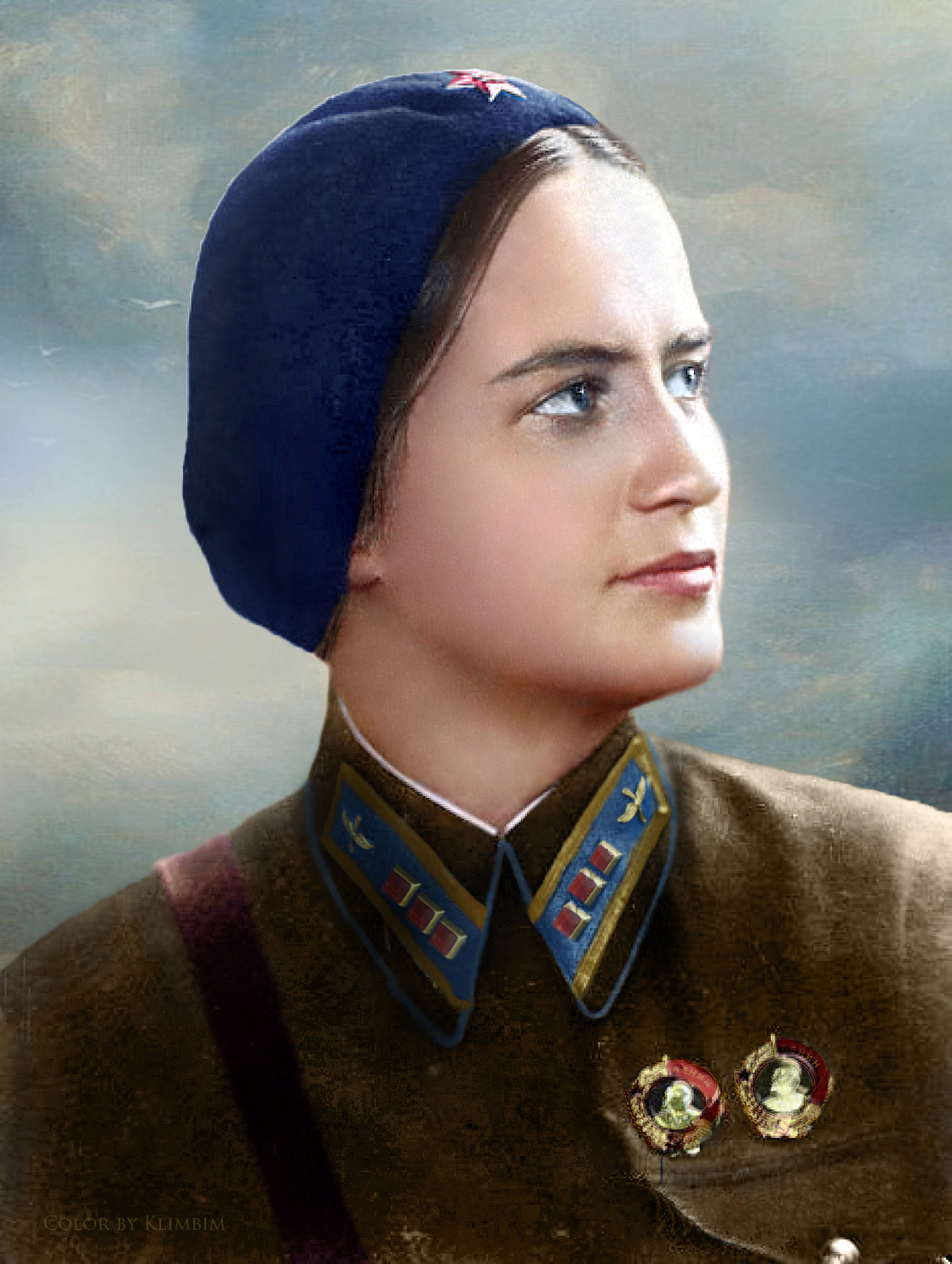
When war broke out in 1941, Raskova was active in promoting public support for the war effort. In one famous speech given in Moscow on 7 September 1941, Raskova noted that Soviet women, whether currently working in agriculture, industry, or the professions, were “ready at any moment to sit down in a combat machine and plunge into battle.” She urged women to “stand in the ranks of the warriors for freedom!”
It was Marina Raskova who instigated the creation of all-female combat aviation regiments. All accounts indicate that forming the units was Raskova’s idea, and that she persuaded the government to agree. Despite her own influence and the availability of women pilots, Raskova met opposition in getting official approval for the women’s regiments. However, she received approval to form the 122nd Aviation Group from which three all-female combat regiments would be created.
Raskova completed the initial organization, formation, and recruitment of the 122nd in an astonishingly short period of time. She received official approval to create women’s aviation regiments on 8 October; began interviewing on 10 October; and on 17 October 1941, oversaw the evacuation and transfer of her entire organization from Moscow to the city of Engels, several hundred miles east. The journey took nine days by train; Raskova spent time in each of the cars during the course of the journey. One trainee recalled that Raskova “was always fresh, neat, energetic. Her authority and simply her personal charm in large part contributed to the strengthening of discipline and order in our still motley military unit.”
At Engels, the female trainees underwent an extremely condensed, intensive course of training. Raskova directly supervised the training of all three regiments, and since one regiment was training for night work, it was a 24-hour-a-day job. She also sat in on many classes and took examinations, as she prepared herself to fly the Pe-2 dive bomber. One pilot noted, “It seemed that she never rested. . . To all of us it seemed that this woman possessed unprecedented energy.” Raskova was soft-spoken, though firm, and was beloved by her subordinates to the point of idolization. Her aide described her as “gentle and tactful” and wrote, “I don’t remember a single case when she yelled or even raised her voice , or rudely interrupted a subordinate. Her method of education was persuasion.”
When training was completed, Raskova took command of the 587th Bomber Aviation Regiment (later 125th Guards). Sadly, she never had the chance to fly in combat. On 4 January 1943, en route to the regiment’s first operational post near Stalingrad, Raskova was flying the lead aircraft in a three-ship formation of Pe-2 dive bombers when a winter storm closed in. Unable to locate an airfield, with darkness closing in, they had no choice but to try to land. Two of the Pe-2s landed safely in a field, but Raskova’s aircraft crashed, killing everyone aboard: Raskova and three men (the regimental navigator, the gunner, and a mechanic who was hitching a ride). At the age of 30, Raskova was dead; her body was interred at Red Square in Moscow. For ten days, the newspapers carried tributes, copies of speeches, and letters signed by people like Stalin and Grizodubova. Raskova’s death was a severe blow to the regiments; when she died, many feared the regiments would be dissolved.
Some later observers have questioned Raskova’s flying skills; others have suggested she should never have been permitted into a command position without having had the usual preliminary military command experience, but should have remained a staff officer, overseeing the women pilots from headquarters. But Raskova, like so many Soviet women, wanted to be in combat herself. Other inexperienced women pilots proved themselves quite capable during the war in both flying and leadership positions. Raskova’s death is most likely attributable to weather, chance, and perhaps fatigue.
It appears that Raskova was genuinely loved by virtually all who knew her. Many women veterans commented that the impression she made upon them in person was even more profound than when they had idolized her from afar. Raskova is regarded with deep affection and respect and was truly a pioneer in aviation.
There is no scholarly study in English that is devoted solely to Marina Raskova, although she is prominently featured in my book Wings, Women, and War. Even in Russian, there was no solid historical work on Raskova until historian Maria Lukoyanova recently published two books and a series of pamphlets on Raskova. Lukoyanova’s work is engagingly written, based on extensive archival research, cites her sources, and is far and away the best source on Raskova.
Excerpts from her longer works can be found here: https://dzen.ru/raskova. Web browser translators make it easy to read these outstanding essays.
“Учёба В Энгельсской Военной Авиационной Школе Пилотов: В Воспоминаниях И Письмах Личного Состава Женских Авиаполков (Studying at the Engels Aviation Pilot School in the Memoirs and Letters of the Personnel of the Women’s Aviation Regiments).” (2019)
«Мне Не Придется Больше В Бою Доверять Свою Жизнь…» Письма Марины Расковой Из Энгельса (“I Won’tHave to Trust My Life in Battle Anymore..” Letters from Marina Raskova from Engels).” (2021).
“Особенности Регистрации Советских Авиационных Рекордов (На Примере Перелётов Штурмана М. М. Расковой),” (Specifics of the Registration of Soviet Aviation Records (Based on the Flights of Navigator M. M. Raskova)m Учёные записки Орловского государственного университета 2(91) (2021).
Марина Раскова. За Страницами “Записок Штурмана” (Marina Raskova. Behind the Pages of “Notes of a Navigator”).” Saratov, 2024.
Пропавшая «Родина». История Самого Впечатляющего Женскогорекорда (the Lost “Motherland.” The Story of the Most Impressive Women’s Record).” Saratov: Техно-Декор, 2025.



Leave a Reply